COUNTRY — ENGLAND
England: youth voice, creative pedagogy and teacher education
Leeds Beckett University · Dr Lisa Stephenson. Youth-informed creative pedagogies and curriculum co-design.
 01
01Staff, university and country context
Leeds Beckett University. Project lead: Dr Lisa Stephenson. England’s strand sits within a period of policy transition shaped by the Curriculum and Assessment Review, the government’s response and the 2026 schools white paper. It examines how teacher education can respond to ambitions for inclusion, SEND, equity and wider participation while schools continue to work within established curriculum, assessment and accountability structures.
Youth participation sessions
Twenty-five young people took part in arts-based youth voice workshops: eight in Bolton and 17 in Leeds. Through ‘I stand for’ and ‘We need’ statements, multimodal artefacts, protest signs, Forum Theatre, post-its, audio and dialogue, they identified challenges, barriers and recommendations that became catalysts for the ITE programme. Priorities included voice and agency; equality, inclusion and anti-racism; wellbeing and safety; responsive and interactive teaching; creativity and self-expression; belonging; and collective responsibility.
Youth inquiry in action
Participants worked collectively across images, written prompts and a shared paper surface, building a visible record of concerns, connections and recommendations.
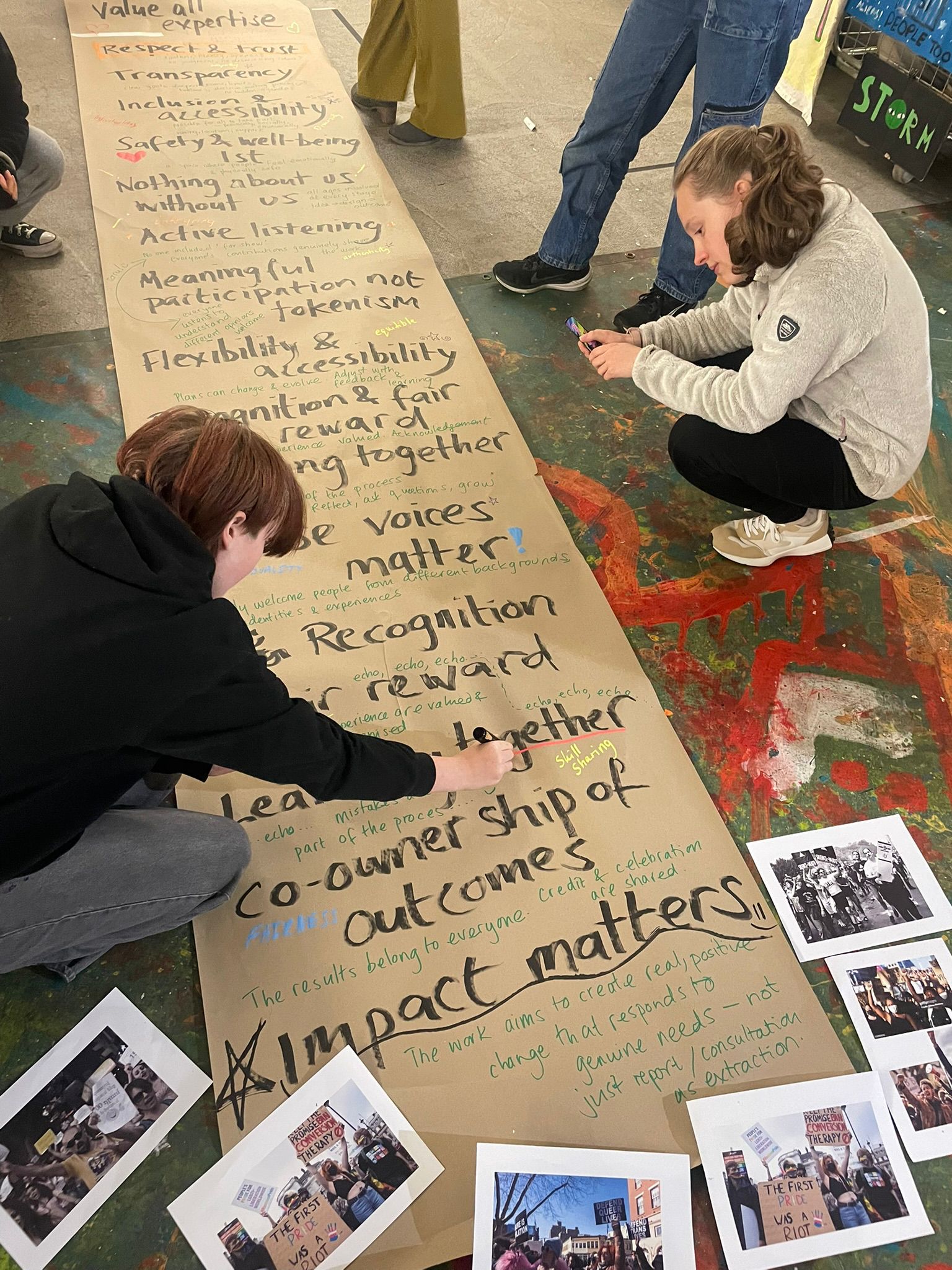
Youth priorities and youth voice
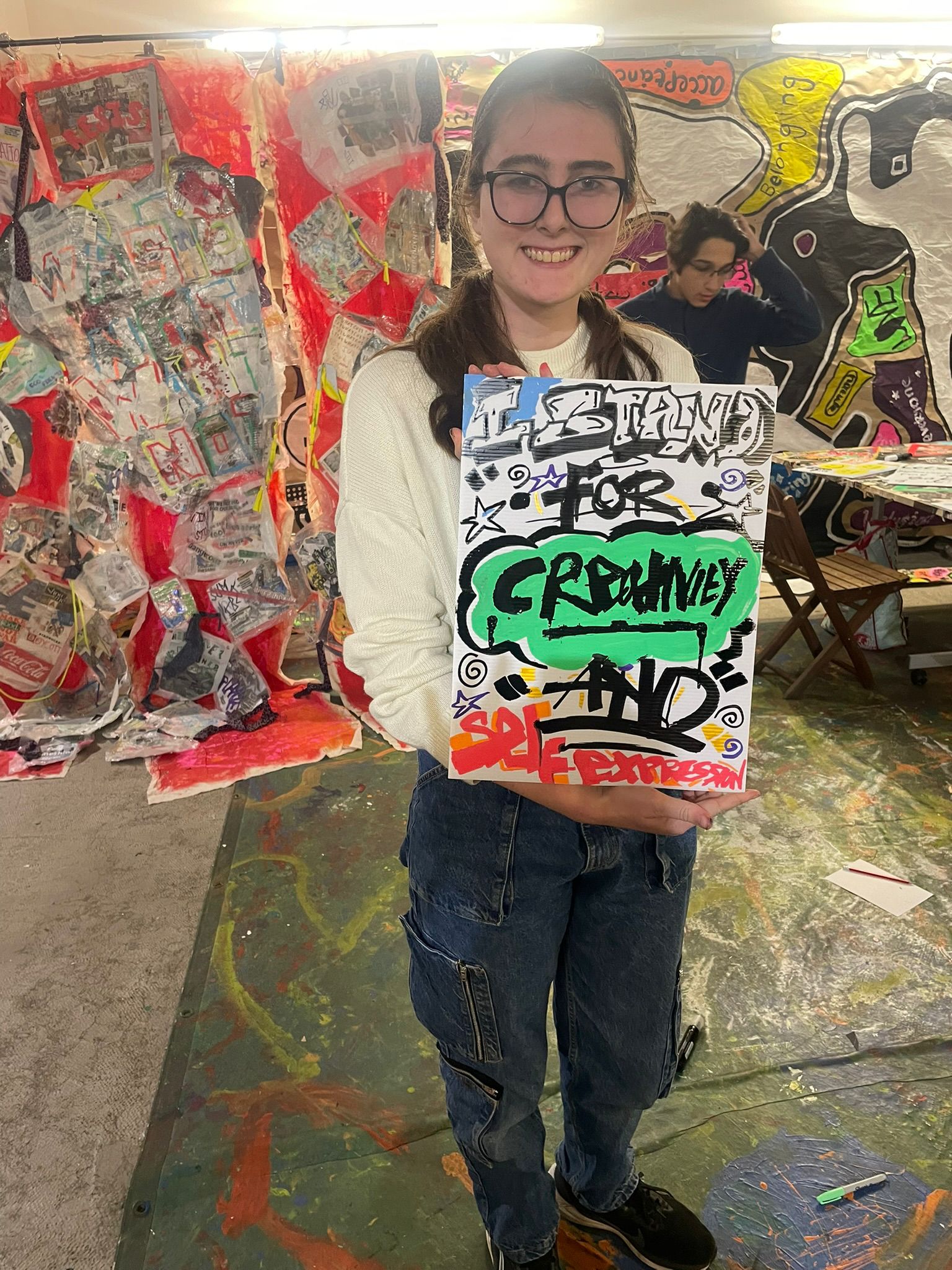
Young people’s evidence was developed through co-participatory and arts-based inquiry, identifying ten priorities for education and future teachers. This participant’s artwork foregrounds creativity and self-expression as educational priorities.
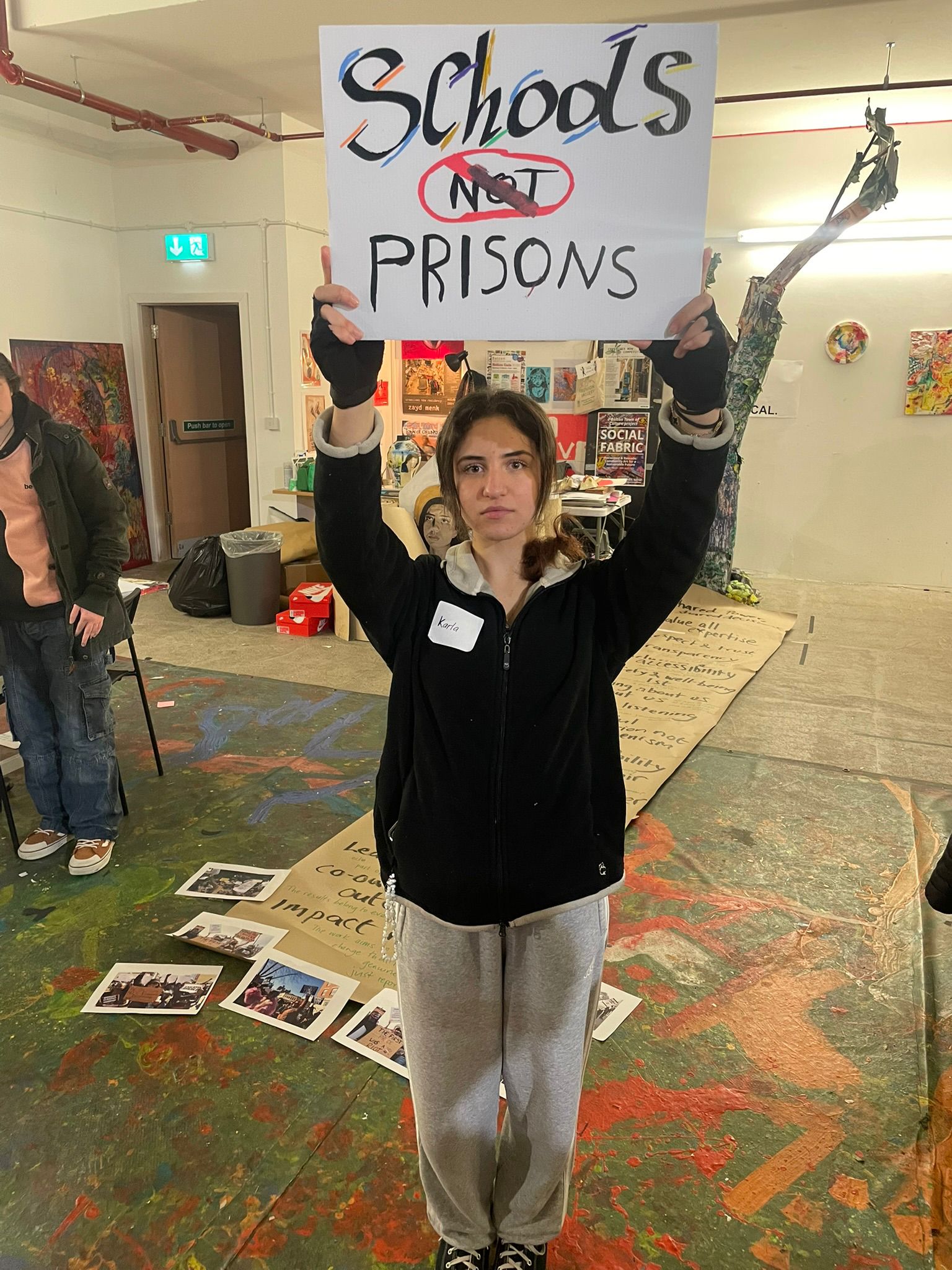
Education through young people’s words
Protest-style statements enabled participants to communicate direct critiques and aspirations. They are presented as situated youth evidence from the England sessions, not as claims shared by every participant.
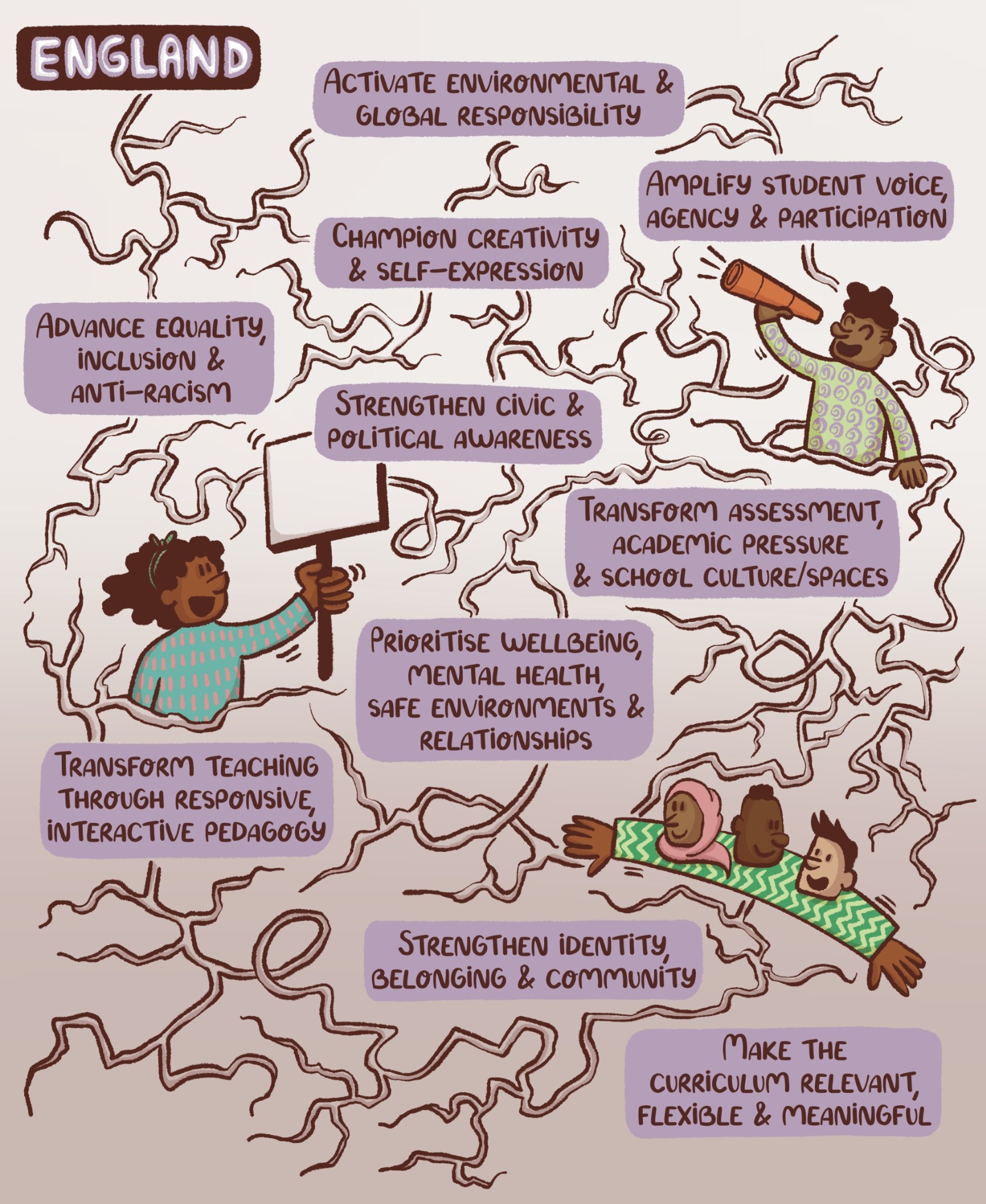
England Youth Catalysts illustration
07Youth Catalysts for Action
- Amplify Youth Voice, Agency and Participation — Move from expression to serious listening, influence and shared decision-making.
- Advance Anti-Racism, Equality and Inclusion — Challenge discrimination, stereotyping and unequal access through representation, accessibility and anti-racist education.
- Prioritise Wellbeing, Safety and Respect — Create emotionally safe, compassionate and respectful relationships and learning environments.
- Make Curriculum and Pedagogy Relevant, Responsive and Engaging — Connect learning with real lives, learner needs, meaningful choice and interactive, student-centred pedagogy.
- Champion Creativity and Self-Expression — Make space for imagination, the arts, experimentation and different ways to communicate.
- Transform Assessment and Reduce Academic Pressure — Recognise different strengths and reduce the harms of narrow testing and excessive pressure.
- Build Compassionate Communities and Collective Responsibility — Develop empathy, cooperation, solidarity and meaningful connection with local communities.
- Strengthen Civic and Political Awareness — Support critical thinking, democratic participation, rights, justice and informed action.
- Activate Environmental and Global Responsibility — Connect sustainability, nature, peace and ethical responsibility for shared futures.
- Strengthen Identity, Belonging and Connection to Place — Represent diverse identities and connect learning with culture, neighbourhood and local knowledge.
Partners
University partner: Leeds Beckett University. Creative practitioners, Creatives Now CIC (Bolton), Leeds Youth Council.
Pedagogical response
Three two-hour artist-led sessions involved 120 ITE students. Creative writing and outdoor story-making with Dan Ingram-Brown used sensory stimuli, outdoor noticing, narrative choice and reflection to explore agency, imaginative freedom, identity, place and wellbeing. Culturally responsive drama with Siara Illing-Ahmed used personal story, role on the wall, dialogue, role play and Forum Theatre to examine equality, anti-racism, culture, democracy and belonging. The workshops enacted selected youth priorities rather than claiming to cover them all.
ITE learning and voices
Repeated ‘I stand for’, ‘We need’, reflection and change activities connected youth evidence with students’ biographies, placement experiences and future professional action. Evidence includes workshop reflections, a two-hour focus group with nine volunteers, 54 anonymous pre-workshop questionnaires and 23 named post-workshop questionnaires. The unequal, non-matched survey samples support a cohort-level account of perceived development, not individual gain scores.
What students said
- “I feel more prepared, as I have seen it in practice and experienced it.”
- “Prior to this, I wouldn’t have thought of this pedagogical approach to teaching, so I would now like to use this within my next placement.”
- “I can actually be creative.”
- “Everyone has different experiences to me and a different cultural background or perspective, so my actions may come across in a way I do not intend.”
- “They created a supportive environment where different viewpoints were encouraged and valued.”
Emerging impact
- The clearest movement was from general belief in creativity and empathy towards embodied, practical understanding of how creative pedagogy might work.
- 87% reported a stronger understanding of how discussing emotions can deepen understanding.
- 83% reported greater confidence in understanding how others may feel.
- 78% felt more comfortable expressing imaginative ideas.
- 78% felt more willing to explore uncertainty and experiment.
- 82% felt more confident using creative approaches for social-emotional wellbeing.
- 76% reported greater connection and belonging through creative collaboration.
- A minority reported no change, uncertainty or reduced confidence, showing that participation does not automatically create preparedness or belonging.
- These figures describe post-workshop respondents and should not be read as matched individual gains.
What the evidence adds
Youth priorities shaped both workshop content and pedagogical form. Students largely validated those priorities, translated them into classroom intentions and extended them through professional concerns about SEND and neurodiversity, emotional literacy, safeguarding, facilitation and placement culture. Assessment pressure, environmental responsibility and wider curriculum choice remained less fully addressed and should stay active in future co-design.
Conditions for responsible implementation
- Embed repeated practice across ITE rather than relying on isolated workshops.
- Make curriculum purposes, progression and evidence of learning explicit.
- Connect university learning with placements, mentors and authentic classroom cases.
- Balance learner agency with structure, sensitive facilitation and pedagogical debriefing.
- Build in safeguarding, informed choice, fictional distance and alternatives to personal disclosure or performance.
- Return findings to young people as critical feedback and an iterative co-design catalyst.
Research and resources
The England analysis integrates youth workshops, artist-led ITE sessions, focus-group reflection, questionnaires and post-workshop reflective responses. Future publications and downloadable materials will distinguish direct evidence, participant perception, observed pedagogical change and longer-term impact.